

I recently co-lead a workshop with Dani Lefrancois for Destination Earth Photo Tours to photograph the white horses of the Camargue in France.
The Camargue horses are one of the world’s oldest breeds, native to the marshy wetlands of the Camargue region in southern France, where the Rhône River delta meets the Mediterranean. They’re often called “the horses of the sea,” and their exact origins remain a mystery – some believe they descend from prehistoric horses depicted in nearby cave paintings, while others trace them to ancient trading and migration routes through the region.
What makes them so striking is their coat: foals are born dark brown or black, but gradually lighten as they mature, turning to their signature grey-white by the time they’re four to seven years old. They’re compact, sturdy, and remarkably hardy, having adapted over centuries to the harsh, marshy terrain, biting insects, and shifting climate of the delta.
These horses still roam semi-wild in the region today. Traditionally, they’ve been ridden by the “gardians” (Camargue cowboys) who herd the bulls, and they remain deeply tied to the area’s culture and identity – so much so that in 1978 the breed received official protection, with strict rules about where they can be born and raised to preserve their heritage.
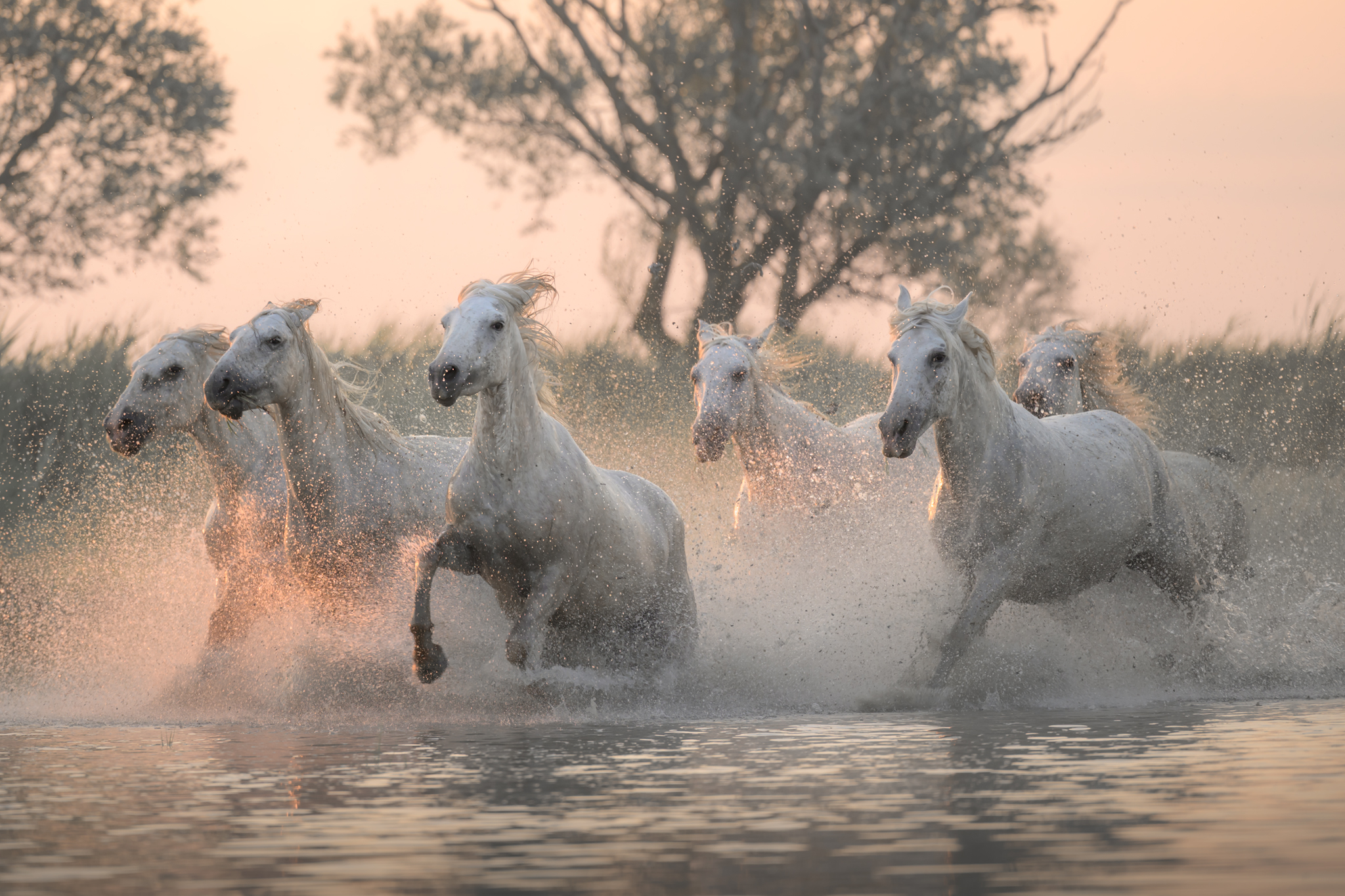
The above image was photographed on the first morning of the workshop in a marshy area. We arrived fairly soon after sunrise and the morning sun was beginning to light the scene.
I chose to position myself so that the horses would be backlit, picking a fairly fast shutter speed of 1/500 sec. Usually for a subject like this, you might choose an f stop that would provide a good depth of field from front to back of the scene – perhaps around f8, however, I was wanting to experiment with a more ethereal feel and therefore chose f2.8 but was mindful to try and choose which horse would be my main subject and therefore where to place the focus – not always easy with a fast moving and fairly chaotic subject as you try to determine which horse is in front. I shot with my Nikon Z8 in Continuous AF (AF-C) using single-point focus, moving the point manually myself instead of letting the camera’s subject tracking do the work.
Below is the RAW unedited image.
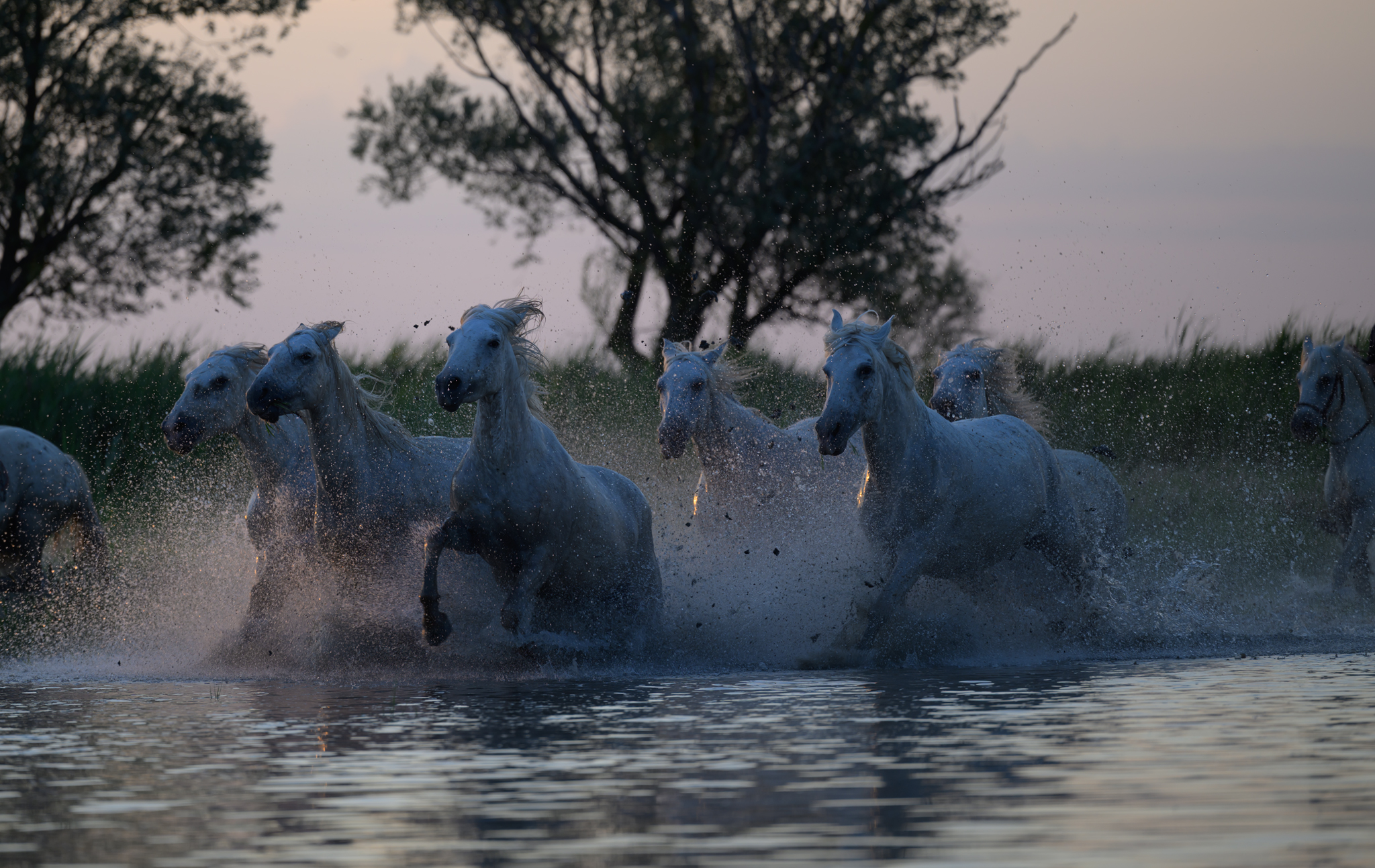
The technical details:
- Camera: Nikon Z8
- Lens: NIKKOR Z 70-200 2.8 VR S
- Focal length: 200 mm
- ISO: 110
- Aperture: f 2.8
- Shutter speed: 1/500 sec
- Focus mode: Continuous
- Mode: Manual
Editing:
As always when I edit, I think first about the kind of mood and story I want to convey. For this image, I was looking for something that felt quite soft, warm and ethereal.
The bulk of my editing took place in Adobe Lightroom.
After my initial steps of cropping and straightening, I made some overall adjustments to temperature and exposure – increasing temperature from 4200k to 6648k and lifting the exposure.
I lifted the shadows slightly, pulled back the highlights and increased the whites by a touch. I also made some adjustments in the colour mixer panel to desaturate the greens and shift their hue towards yellow.
I targeted the horses specifically using intersecting masks to increase exposure just on them.
I lowered the contrast in the background to keep the feeling soft and light and to reduce the blacks in the dark branches of the trees so as not to take away from my main subject of the horses.
I added a linear gradient in the foreground to darken that area and close off the bottom of the frame.
I used some colour grading to move the shadows towards a green tone and to desaturate them.
I cloned out some larger clumps of dirt that were flying.
I finished in Adobe Photoshop by adding some gentle orton effect just to the lightest parts of the image using luminosity masks. The idea here was to add some glow to the highlights to again, create an ethereal soft mood.
If you’re interested in learning more about my photographic and editing techniques and thought processes, I offer mentoring sessions in person or via Zoom so please get in touch!